Metropolitan Police Promotion Board Preparation
If you’re preparing for a Sergeant, Inspector or Chief Inspector board at Metropolitan Police, your panel already knows your force’s inspection picture. Here’s what that means for you, and how State6 builds it into your preparation.
PEEL report
15 August 2024
2023-25 PEEL inspection
Grades
8 areas
Causes of concern
2
in the latest PEEL report
HMICFRS support level
Level Two
Early or low-level concerns, as published 16 July 2026. What this means
Metropolitan Police HMICFRS snapshot
What the inspectors found
The Metropolitan Police faces serious concerns following the 2023-25 PEEL inspection, graded inadequate for both investigating crime and managing offenders, and requiring improvement across five further areas including leadership, workforce, and responding to the public.
PEEL grades
- Managing offendersInadequate
- Investigating crimeInadequate
- WorkforceRequires improvement
- LeadershipRequires improvement
- Preventing crimeRequires improvement
- Responding to publicRequires improvement
- Protecting vulnerableRequires improvement
- Police powersAdequate
Causes of concern
- Investigating crime
- Managing offenders and suspects
Areas for improvement
- The force doesn't always record the ethnicity of the people stopped and searched by its officers
- The force needs to make sure its data is accurate and robust enough to understand the reasons for the disproportionate use of force
- The force's systems, management processes and training need to support consistent, effective problem-solving
- The force needs to minimise the time that neighbourhood officers are diverted away from their main duties to cover excess demand in response teams
- The force needs to improve how it involves the community in local decision‑making
- The force needs to attend calls for service in line with its published attendance times
Show the other 15 areas for improvementHide the extra areas for improvement
- The force doesn't consistently achieve good outcomes for victims
- The force needs to make sure it assigns outcomes appropriately and complies with its own and national policies
- The force should align its central and local governance arrangements to protect vulnerable people and create service improvements
- The force needs to improve how it communicates with vulnerable people to improve the service it provides to the public
- The force needs to improve its use of preventative orders and notification schemes to protect vulnerable victims
- The force needs to make sure all personnel have suitable training, skills and experience to carry out safeguarding roles and functions
- The force should make sure that officers and staff understand the purpose of risk assessments and that referrals to partners include all relevant information
- The force needs to reduce the number of outstanding suspects and make sure officers and staff are aware of the priority list of outstanding higher-risk suspects
- The force needs to develop a consistent welfare service for the whole workforce
- The force needs to better understand the challenges faced by new recruits to encourage them to remain in its workforce
- The force needs to make sure that members of its workforce from under‑represented groups are aware of, and take up, the opportunities to develop and progress
- The force needs to improve its business planning processes
- The force needs to make sure leaders throughout the force understand what is expected of them to implement the 'A New Met for London' plan
- The force needs to improve its workforce planning and its understanding of its officers' and staff's skills so that it can deploy them more effectively
- The force needs to improve the quality of its data and how it is used
21 areas were identified in the full inspection. Inside State6, each is mapped to the Met Success Profile areas it affects, so you know exactly what to evidence.
Source: Metropolitan Police’s inspection reports on the HMICFRS website.
In their own words
What the Met says it is focused on
The inspection picture above is what HMICFRS found. These are the priorities the Metropolitan Police and its Mayor have set for themselves, and the people on your panel work to them every day.
Police and Crime Plan 2025 to 2029
Set by the Mayor of London through the Mayor's Office for Policing and Crime. It is published under the name A Safer London for Everyone.
- Reducing Violence and Criminal Exploitation
- Building safer, more confident communities
- Supporting and overseeing reform of the MPSBacking the force's own reform programme while scrutinising delivery and holding the force to account for it.
- Improving the Criminal Justice System and supporting victims
A New Met for London Phase 2 2025 to 2028
Set by the Metropolitan Police Service. It is the second phase of the plan the force first published in 2023. Stated aim: More Trust, Less Crime and High Standards.
- Community Crime-fightingPolicing rooted in neighbourhoods, with effort concentrated on the few offenders doing most harm and on the places and victims worst affected.
- Culture ChangeA culture that backs officers and staff in the job, alongside firm standards and the removal of anyone who falls short of them.
- Fixing our FoundationsSupport for officers and staff through training and development, better health and wellbeing, and a headquarters run efficiently behind the front line.
- Putting Crime-fighting FirstSpending less time on work that is not crime and less on bureaucracy, with technology used to raise productivity.
- Working in PartnershipCollaborating with partners on jointly agreed priorities, and taking on fewer opportunities so partnership work achieves more.
Use these to choose which of your examples to tell, not as phrases to recite. An answer about a team problem lands harder when the panel can see it serves something the force has already said matters.
Priority names are the publishers’ own headings. The summaries are ours. Checked against the published documents on 7 October 2026.
The Met runs its own process
The Metropolitan Police board is no longer the College of Policing Competency and Values Framework test the other 42 forces sit. The CVF still underpins the criteria, but it’s no longer the test itself. The Met now runs a future-focused interview that assesses your potential to perform at the next rank, scored from 1 to 4 against its own Success Profile. Prepare as if it’s a standard CVF board and you’re ready for the wrong process.
State6 is built on the Met’s actual published criteria, so you prepare for the real thing:
- Future-focused questions on the Met Success Profile areas: Integrity, Leads Inclusively, Being Resilient, Planning and Prioritising, and Drives Engagement.
- An AI review that scores your written answer on the Met’s 1 to 4 potential model.
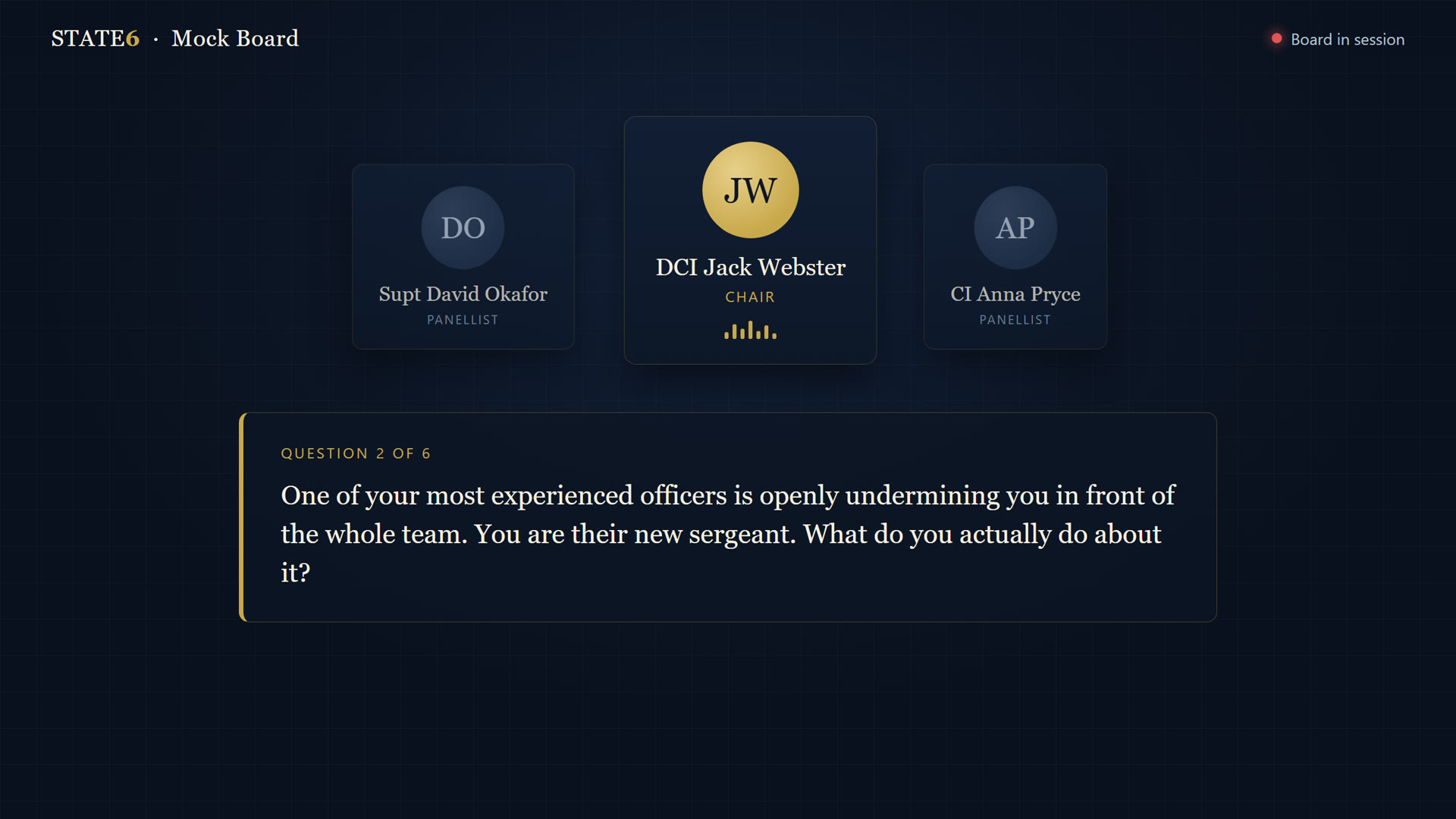
- A spoken AI mock board that runs the Met way and debriefs you on your potential.
- Force Intelligence pairing the Met’s HMICFRS findings with the New Met for London reform plan.
Most other promotion preparation, free or paid, is still built around the CVF. For the full picture, read our guide to Met police promotion in 2026.
Recent inspection activity
Inspections published since the last full PEEL assessment. These are often the most current picture of Metropolitan Police, and the areas your panel is most likely to be conscious of right now.
Custody inspection · 7 August 2025
Report on an inspection visit to police custody suites in the Metropolitan Police Service
No formal grades or ratings are assigned in this report; instead, a cause of concern, one recommendation, and 20 areas for improvement are identified.
What this means for your board
Metropolitan Police is graded Inadequate for managing offenders and investigating crime. Its Police and Crime Plan 2025 to 2029 leads with the priority “Reducing Violence and Criminal Exploitation”. Your panel knows both without looking it up, and an example that speaks to either is one they will recognise.
A promotion board at Metropolitan Police isn’t only assessing whether you can lead a team. It’s assessing whether you understand the force you’re asking to lead in, and where your leadership fits its priorities. Officers who connect their examples to what Metropolitan Police is actually focused on stand out. Officers who stay inside their own team don’t.
You don’t do this by quoting the inspection report. You do it by letting your force’s priorities shape the decisions in your answers. If you want the full method, read our guide on what HMICFRS grades mean for your promotion board, or compare every force’s PEEL grades side by side.
How State6 prepares you for Metropolitan Police
You don’t have to research any of this yourself. The Met’s real picture, its inspection findings and its New Met for London reform plan, is built into State6, and every question and AI review is set on the Met’s own future-focused model and its 1 to 4 potential scale. You prepare for the board you’ll actually sit, on the criteria you’ll actually be judged against.
That includes a spoken AI mock board run the Met way, where you answer out loud while the panel probes and debriefs you on your potential from 1 to 4.
Prepare for your Metropolitan Police board
Practice questions, AI board reviews and your force’s inspection picture, all in one place. Try it free first: one AI Board Review, ten practice questions and fifteen coaching rounds, no card needed.
State6 is an independent preparation platform and is not affiliated with, endorsed by, or connected to Metropolitan Police, the College of Policing or HMICFRS. Inspection findings are summarised from the publicly available HMICFRS PEEL reports.
HMICFRS inspection data: Contains public sector information licensed under the Open Government Licence v3.0.