Met Police Promotion 2026: The Future-Focused Interview, Scored on Potential
By State6 Prep · Written by serving officers, built on the Met’s own model.
The Metropolitan Police scores promotion differently from every other force in the country. Its board is a future-focused interview that marks your potential to perform at the next rank from 1 to 4, against five indicators.
The College of Policing Competency and Values Framework still underpins the criteria, but it’s no longer the test. Prepare as if it’s a standard CVF board and you’re ready for the wrong process.
This guide covers how the Met process works in 2026, how the interview is scored, the role specific leadership exercise, the ready for promotion gateway, and how to show potential rather than describe it. State6 is built on that actual model, so you prepare for the board you will sit.
Met candidates can use State6’s future focused interview coaching free, built around the Met’s published assessment model rather than the standard CVF. The trial gives you a full AI Board Review, ten practice questions and fifteen coaching rounds, marked on the same 1 to 4 potential scale the Met uses. No card needed.
Start freeWatch it work · the Met model, end to end
The question generator · Met mode
Rank
InspectorSuccess Profile area
Drives EngagementQuestion style
HypotheticalPick your rank, a Success Profile area and a style. The generator does the rest, on the Met’s own model.
Future-focused question · generated for your rank
As a newly promoted Inspector, how will you rebuild trust with communities who currently see your officers only when something has gone wrong?
Forward-facing, at your rank, on the Met’s own model. No past-example war stories.
The question
As a newly promoted Inspector, how will you rebuild trust with communities who currently see your officers only when something has gone wrong?
Your position · typed
I would make visible trust my first priority. Confidence in us is low and the negative stories keep coming, so getting them to stop would show the command team early that I can deliver. I would start by
Your position
...the negative stories keep coming, so getting them to stop would show the command team I can deliver. I would start by...
AI coaching · round 1 of 3
There is a line here a panel will seize on. When you write 'getting them to stop would show the command team I can deliver', they hear reputation management and personal credit, not service. The Met's values indicator is measured on exactly this. Ground your why in what low trust costs those communities, and your first priority reads as theirs, not yours.
Potential debrief · the Met scale
Scored on potential, not the past
3
of 4
Curiosity
ShownLeadership behaviours
ShownAlignment to Met values
BuildingThe verdict
Acceptable, tracking toward High. The rewritten position now leads with the communities, and the plan survives the integrity check.
Contents
Section 1 · How Met Promotion Works in 2026
The Met scores potential, not past examples
The Met has moved from scoring what you have done to scoring what you could do. The board is no longer the College of Policing Competency and Values Framework (CVF) test the other 42 forces sit. The CVF and the Met values still underpin the criteria, but they are no longer the test itself.
In its place is a future-focused interview, scored on your potential, alongside a role specific leadership exercise. A potential rating in your Professional Development Review now acts as the gateway into the process. This is part of the wider A New Met for London reform, the direction the Met set after the Casey Review. It sits within the national framework, the National Police Promotion Framework (NPPF), but the assessment itself is the Met’s own.
For the detail on the CVF question specifically, read what’s actually changed in Met promotion for 2026.
Section 2 · How the Met Interview Is Scored
The 1 to 4 potential scale
Each answer is scored from 1 to 4 against your potential to perform at the next rank. There is no fifth band, and there is no separate competency score.
The five indicators of potential
That judgement is made against five indicators. They are not scored one by one in front of you. They run underneath every answer, so a strong response shows several at once:
- Learning agility: how quickly you take on new situations, unlearn old habits and apply what you have learned.
- Self-awareness: knowing your own strengths and growth areas, and how the way you operate lands on the people around you.
- Curiosity: a genuine drive to ask questions, understand the why and look for a better way.
- Leadership behaviours: how you influence, bring people with you and take the initiative without being told to.
- Alignment to Met principles and values: whether your behaviour role-models what the Met says it stands for, including its directly assessed Integrity.
For a full breakdown of the scale and what separates a 2 from a 4, read what potential means in Met promotion.
Section 3 · The Two Exercises
The Met assessment centre has two exercises. The first is the future-focused interview, where you answer questions on how you would lead in the rank you are applying for, scored on your potential. The second is a role specific leadership exercise, a realistic exercise that tests your leadership judgement in a scenario built around the role, as currently published.
Most preparation, free or paid, covers neither properly, because most preparation is still built around the CVF. We explain both. Start with the role specific leadership exercise, the part nobody else explains.
Section 4 · What the Interview Assesses
Five Success Profile areas, each explored through future-focused questions and scored on your potential:
Integrity is not only an area, it is directly assessed. An approach that games a number or chases a target at the public’s expense is a concern, not a strength, however polished the answer sounds.
Section 5 · The Ready for Promotion Gateway
The front door has changed too. A potential rating in your Professional Development Review now acts as the gateway into the process, in place of the old application form, alongside a gamified first stage, as currently published. Reaching a ready for promotion rating or above is what lets you progress.
For how the gateway works and how to earn the rating, read the Met’s ready for promotion PDR gateway.
Section 6 · What a Strong Answer Looks Like
A future-focused answer takes a clear position on how you would lead, then shows the thinking behind it. The difference between a low band and a high one is whether the panel can see your potential, or only your past.
Lower band
When I was acting up I dealt with a similar problem by speaking to the team and sorting it out. I would do that again.
Higher band
My priority would be to understand what is actually driving it before I act. I would test my own assumptions first, because I have been wrong before by moving too quickly. The tension is that being seen to pause can look like indecision, so I would be open about why I was taking the time, and I would judge it worked when the team brought problems to me earlier rather than later.
These are illustrations of structure, not a script to memorise. The steps below are how you build one.
- Take a position. Say clearly how you would lead, decide or act in the rank you are applying for. Do not narrate a past job and hope the panel infers it.
- Ground your thinking. Show the reasoning behind your approach: the priorities you are weighing, the evidence you would draw on, the people you would bring with you.
- Name the tension. Take the strongest honest challenge to your approach and engage with it. A future-focused answer that pretends there is no downside reads as untested.
- Commit to specific action. Set out the sequence you would actually follow at this rank, and how you would know it was working. Vague intentions do not score.
- Hold the line on integrity. Make sure your approach is legitimate, not a shortcut that games a number or chases a target at the public's expense. Integrity is assessed directly.
For more on forward-facing answers, read the Met inspector future-focused interview and our guide to structuring a forward facing question.
Section 7 · How State6 Prepares You
Prepare on the Met’s model, not a CVF board
State6 is the only preparation platform built on the Met’s actual model. You practise future-focused questions on the five Success Profile areas, and an AI review marks your written answer against the 1 to 4 potential scale and the five indicators, then tests the integrity of the approach you have taken.
- Future-focused questions set on the Met Success Profile areas.
- An AI review that scores your answer 1 to 4 on potential and names what is holding the band down.
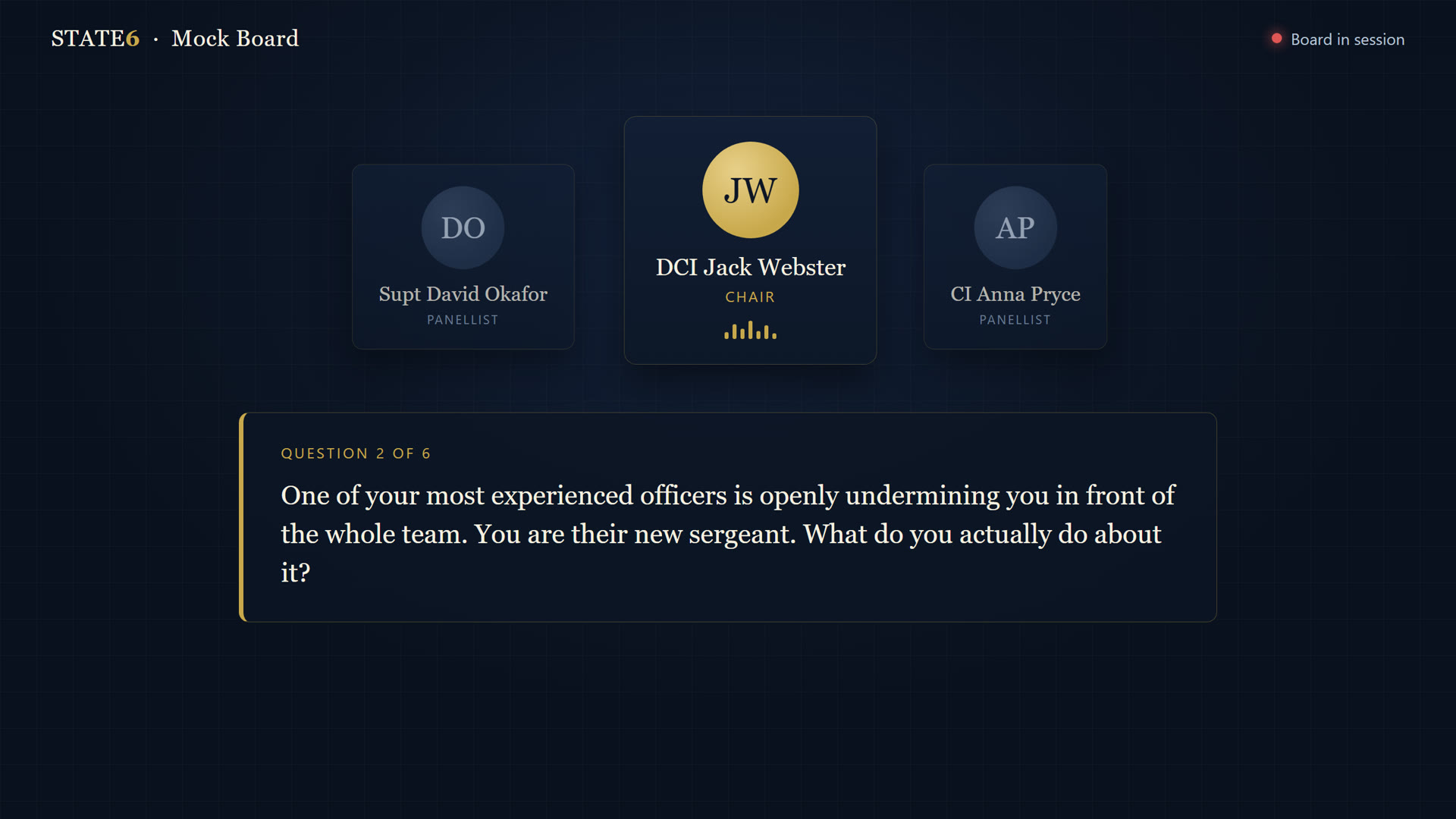
- A spoken AI mock board run the Met way, where you answer out loud and get debriefed on your potential.
- Force Intelligence pairing the Met's HMICFRS findings with the New Met for London reform plan.
The full voiced board experience, including how it marks Met candidates on the 1 to 4 potential scale, is on the Mock Board page.
Go State6 →Section 8 · The Met Promotion Guides
- Met inspector promotion: the future-focused interview, scored 1 to 4
- What's changed in Met promotion for 2026 (and the CVF question)
- The Met inspector role specific leadership exercise
- The Met's ready for promotion PDR gateway
- What potential means, and what a 1 to 4 score looks like
- A New Met for London: what the reform plan means for your board
The Met runs its own process, but the fundamentals of leading at rank still apply. For everything else, from the NPPF through to what panels score at each rank, see the complete guide to UK police promotion boards.
Section 9 · Frequently Asked Questions
Does the Met still use the CVF?
Yes, but not as the test. The College of Policing Competency and Values Framework and the Met values still underpin the assessment criteria. What has changed is that the board is no longer a CVF competency assessment. It is now a future-focused interview scored 1 to 4 on your potential.
How is the Met promotion interview scored?
Each answer is scored from 1 to 4 against your potential to perform at the next rank: 1 Limited, 2 Developing, 3 Acceptable, 4 High. The judgement is made against five indicators of potential rather than against past-behaviour competencies.
What are the five indicators the Met assesses?
Learning agility, self-awareness, curiosity, leadership behaviours, and alignment to the Met's principles and values. They run underneath every answer, so a strong response shows several of them at once rather than reciting them.
What is a future-focused interview?
It asks how you would lead, think and decide in the role you are applying for, rather than asking you to recount a time you did something. You can use experience to illustrate a point, but the answer is predominantly forward-looking, so a war story told as the whole answer scores poorly.
What does the Met interview assess?
Five Success Profile areas: Integrity, Leads Inclusively, Being Resilient, Planning & Prioritising, and Drives Engagement. Each area is explored through future-focused questions and scored on your potential, not on how well you handled a past example.
What is the Met's 'ready for promotion' rating?
A potential rating in your Professional Development Review now acts as the gateway into the process, in place of the old application form. Reaching a 'ready for promotion' rating or above is what lets you progress, alongside a gamified first stage, as currently published.
Is the Met promotion process different from other forces?
Yes. The other 42 forces typically score past examples against the CVF on a 1 to 5 scale. The Met assesses your potential on a 1 to 4 scale through a future-focused interview and a role specific leadership exercise. Preparing as if it were a standard CVF board leaves you ready for the wrong process.
Can I use a past example in a Met answer?
Yes, to illustrate how you think or what you have learned. But the interview is predominantly future-focused, so an answer that is only a past example, with no forward reasoning, will not score well.
State6 is an independent preparation platform and is not affiliated with, endorsed by, or connected to the Metropolitan Police Service, the College of Policing or HMICFRS. The Met’s process is summarised from its published officer promotion guidance and the College of Policing framework.