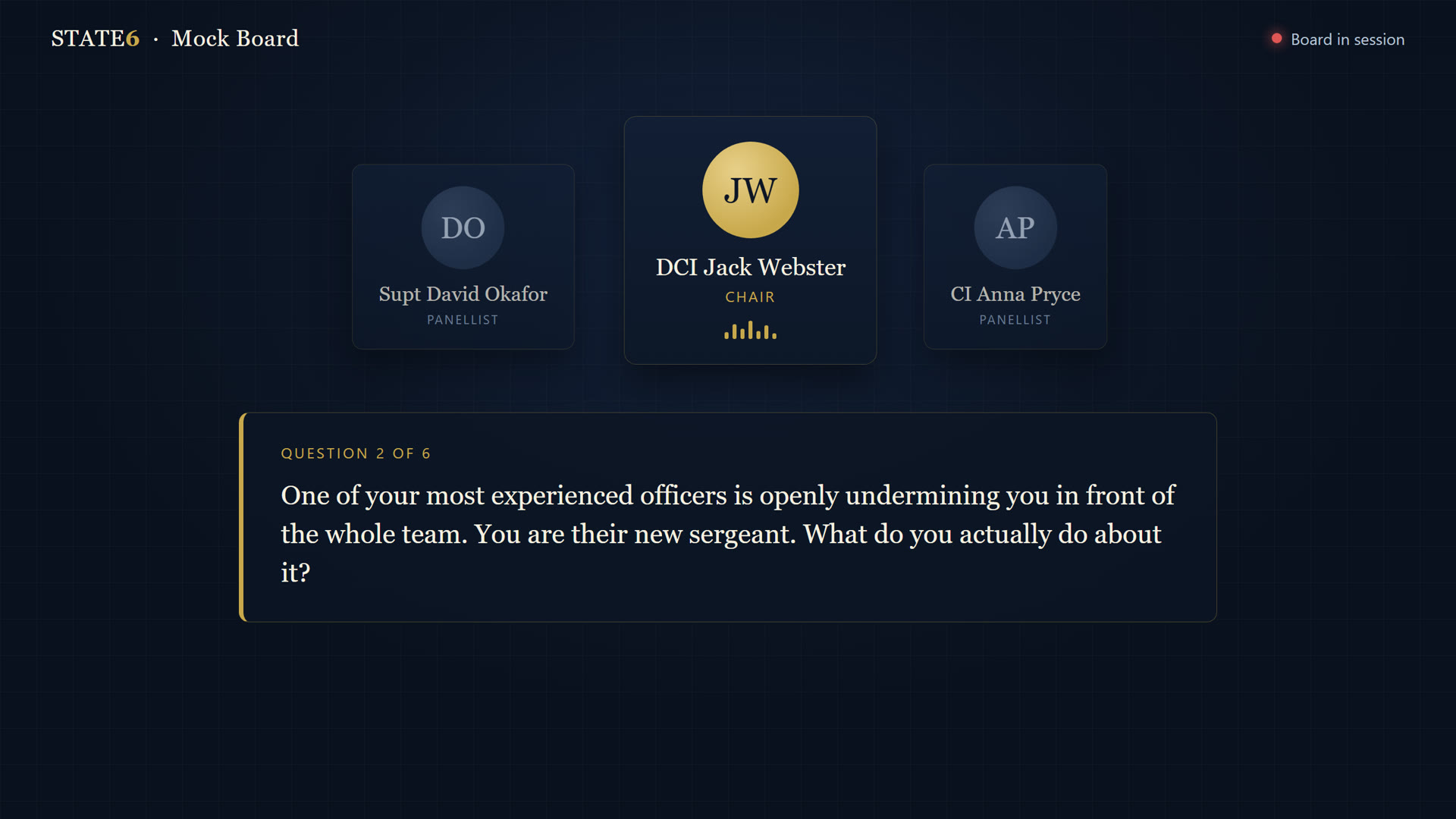
Almost every officer preparing for the Met Inspector promotion spends their time on the interview. The Met role specific leadership exercise (RSLE) is the other part of the assessment, and hardly anyone explains it.
The Metropolitan Police Service runs its Inspector assessment in two parts. One is the future-focused interview, scored on your potential. The other is a role specific leadership exercise: a realistic, role-based scenario where you have to lead. As currently published, the exercise sits alongside the interview as one of the two assessed parts. Walk in having prepared only for the interview and you have prepared for one part of it.
What is the Met inspector role specific leadership exercise?
It's a leadership exercise built around a scenario you would plausibly face as an Inspector. Rather than asking you to talk about leadership in the abstract, it puts you inside a situation and watches how you actually lead it. The exact format and materials can change between rounds, so treat the specifics as published by the Met for your own intake.
What's consistent is the principle. You're given a context, some information to work with, and a task that forces you to make decisions and account for your reasoning. The Met's published officer promotion overview frames the whole process around the leadership the Met wants at Inspector rank, and this exercise is where that leadership is observed directly rather than described.
What is the role specific leadership exercise actually testing?
It's testing leadership judgement under realistic pressure. The interview tests how you think about the role; the exercise tests what you do when you're in it. An officer can be strong on one and weak on the other.
Assessors are watching how you prioritise when you can't do everything and how you weigh competing pressures. They're watching whether you involve the right people and communicate a clear direction, and whether your decisions hold up when someone pushes back. The College of Policing leadership standards for mid-level leaders describe leading by example and holding fairness and accountability together even when that's uncomfortable. The exercise is where a panel sees whether you do that when it costs you something.
Integrity is live here, not just in the interview. A scenario that tempts you toward the gamed figure or the result that looks good on paper is testing whether you'll take it. Chasing the metric at the public's expense is a serious concern, not a clever answer.
How is the leadership exercise different from the future-focused interview?
The interview asks how you would lead. The exercise makes you lead, then watches. In the interview you can structure your reasoning and choose your words. In the exercise the situation moves and you have to respond to what's in front of you, which is harder to rehearse and easier to get wrong under pressure.
The link between them matters. The Met assesses your potential on a 1 to 4 scale, looking at indicators like learning agility, self-awareness and how you lead and collaborate. The exercise is one of the clearest places those indicators show up, because you can claim self-awareness in an interview but you reveal it when you change course mid-scenario after realising your first read was wrong.
How do you prepare for the Met inspector leadership exercise?
Start by knowing what good leadership looks like at Inspector rank, not constable or sergeant. At Inspector the span is wider: you're setting conditions for sergeants and their teams, not directing one officer through one job. Decisions ripple beyond the immediate shift. Prepare to think one level up from where you sit now.
Build a way of structuring a decision under time pressure so you don't freeze when the scenario lands. Read the situation, decide what matters most and why, choose a direction, and be ready to say how you'd know it was working. The point isn't a rigid formula, it's having a reliable way to stay clear-headed when the exercise is designed to overload you.
Practise saying your reasoning out loud. Structured leadership communication is a skill the exercise rewards and most officers under-train. The same discipline behind a strong presentation, taking a clear position and standing behind it, carries straight into a leadership exercise. Our work on the STANCE presentation structure, a State6 Original framework, is built around exactly that habit of communicating a decision with a spine to it.
What does a weak versus strong response look like?
Take a scenario where you inherit a team carrying a backlog, a wellbeing concern and pressure from above to improve a performance figure quickly.
WEAK
I'd reassure the team, get the backlog down as the priority, and keep my chief inspector updated on the numbers so they can see progress.
It sounds responsible. It also dodges every hard part. There's no decision about what gets sacrificed, no read of why the figure is under pressure, and no sign the officer has noticed that pushing the number while a wellbeing concern sits unaddressed is the trap the scenario was built around.
STRONG
My first call is that the wellbeing concern comes before the figure, because if I lean on a team that's already struggling I lose the people I need to fix the backlog properly. So I'd understand the cause of the backlog with my sergeants before touching the target, protect the figure from being gamed by setting out what counts and what doesn't, and tell my chief inspector what I'm prioritising and why rather than just feeding back numbers. I'd know it was working when the backlog falls and sickness doesn't climb to meet it.
Same scenario. One response leads. The other manages.
How does State6 fit a leadership exercise it can't simulate?
We're honest about the line. State6 doesn't replicate the live exercise itself, and you should be wary of anyone claiming to. What State6 does is prepare the thinking the exercise rewards and the part of the assessment that sits next to it. The future-focused interview is built on the Met's actual model: State6 marks your answer against the real 1 to 4 scale and the five indicators of potential, and it tests the integrity of your approach so a gamed shortcut gets caught before a panel catches it.
That's the same judgement the exercise is scoring. The officer who has trained to take a clear position and hold integrity when the easy option is right there walks into the leadership exercise with the instinct already built. We explain the exercise so you know the format, and sharpen the thinking so you arrive ready to lead it.
The leadership exercise is the part of the Met Inspector assessment almost nobody prepares for properly. For how it sits alongside the interview, the potential score and the reformed process as a whole, start with our guide to Met police promotion, and for the wider picture across every force see the complete guide to UK police promotion boards.
You can try the Met review free. Start your free trial and sharpen the future-focused thinking the exercise rewards, no card needed.