The Met scores each answer in its Inspector promotion interview from 1 to 4 against your potential to perform at the next rank, judged on five indicators. That single fact is what most preparation gets wrong about the Met police inspector promotion 2026, and it changes how you should prepare for every question.
The Metropolitan Police Service now runs a future-focused interview. It doesn't ask you to recount a past success and have it marked 1 to 5 against a competency descriptor. It asks how you would lead and decide in the rank you're applying for. If you walk in ready to tell war stories, you will score below officers who arrive ready to think forward.
How is the Met inspector promotion scored?
Each answer is scored on a four-point potential scale: 1 Limited, 2 Developing, 3 Acceptable, 4 High. There is no 5 and there is no "out of 5". It's the number you need fixed in your head before you practise a single response.
The scale measures one thing: your potential to operate as an Inspector, not how polished your recollection of a past incident is. An answer that proves you handled something well as a Sergeant but says nothing about how you'd lead at the next rank sits low, however true the story is.
What is the Met future-focused interview?
A future-focused interview is built around "how would you", not "tell me about a time". The panel wants to see how you'd set direction and lead people through a difficult call in a role you haven't held yet. You can still reach for a past example to illustrate a point, but the answer has to be predominantly forward-looking. A single war story used as the whole answer doesn't show potential, it shows history.
This is the same shift that drives a good forward facing answer at any board. The difference at the Met is that the whole interview is built this way and marked on potential rather than on a competency level. For the full picture, see what changed in the Met promotion process for 2026.
What are the five indicators of potential the Met assesses?
The Met judges potential against five indicators. Knowing them by name lets you check, before you speak, that your answer shows them rather than just sounding confident.
- Learning agility. How quickly you take on new knowledge, drop what no longer works, and apply the lesson next time.
- Self-awareness. Knowing your real strengths, your growth areas, and how you land on the people around you.
- Curiosity. A genuine pull to dig into a problem and improve it rather than settle for how things are done now.
- Leadership behaviours. How you influence, bring people with you, and take the initiative unprompted.
- Alignment to the Met's principles and values. Whether your behaviour actually role-models them under pressure, not just whether you can name them.
For how those five map onto the bands, see how the Met scores potential 1 to 4.
Has the Met dropped the CVF?
No. The Met hasn't stopped using the Competency and Values Framework (CVF). The College of Policing CVF and the Met values still underpin the assessment criteria. What's changed is that the CVF is no longer the test. The test is a future-focused interview scored on potential, with the framework sitting underneath it as the standard your behaviour is measured against.
That distinction tells you what not to do. Don't recite CVF descriptor language at the panel. Show the thinking the framework describes, applied forward, in your own words. The interview also draws on five Success Profile areas (Integrity, Leads Inclusively, Being Resilient, Planning and Prioritising, Drives Engagement) and the Met's own values of Integrity, Courage, Accountable, Respect and Empathy.
What does a strong future-focused answer look like?
Take a question like: "As an Inspector, how would you improve confidence in stop and search across your area?" Here are two ways officers answer it. The first is condensed for the page, a real answer runs longer.
WEAK
When I was a Sergeant we had a problem with stop and search scrutiny, so I reviewed the records, fed back to the team and the figures improved. I'd do the same as an Inspector.
That's a past example used as the whole answer. It tells the panel what already happened and nothing about how you'd lead the issue at the next rank, so on the potential scale it sits low.
STRONG
I'd start by being curious about where confidence is actually breaking down, the data and what the community scrutiny panel is telling us, before I assume the cause. As an Inspector my job is to set the conditions, so I'd be clear with my Sergeants that I want every search lawful and explainable, not a count chased for its own sake. I'd measure success by whether disproportionality narrows and complaints fall, and I'd expect to change my approach as the picture tells me more.
Same question. The strong answer is forward-looking, it leads through the Sergeants rather than doing their job, and it refuses to treat a target as a substitute for legitimacy. That last point matters more than officers expect.
Why does integrity matter so much in the Met interview?
Integrity is directly assessed, both as a Success Profile area and as a Met value. Gaming a metric or chasing a target at the public's expense isn't a clever leadership move at this board, it's a concern the panel will mark you down for. An answer that suggests you'd hit a number whatever the cost reads as a risk, not a result.
This sits inside the Met's wider reform direction. The future-focused model is part of the Met's published officer promotion process and the A New Met for London reform plan, the post-Casey direction for the force. The panel is choosing the leaders that plan needs, so an answer that role-models the values under pressure carries real weight.
How do you prepare for the future-focused interview?
Stop rehearsing stories and start rehearsing how you'd lead. For every likely topic, work out your position, how you'd test your own assumption, how you'd lead through your Sergeants, and how you'd know it was working. Then check the answer shows the five indicators rather than just sounding senior. The interview is one of two exercises at the assessment centre. The Role Specific Leadership Exercise sits alongside it and tests the same potential in action. A "ready for promotion" potential rating in your PDR now acts as the gateway, alongside a gamified first stage, as currently published.
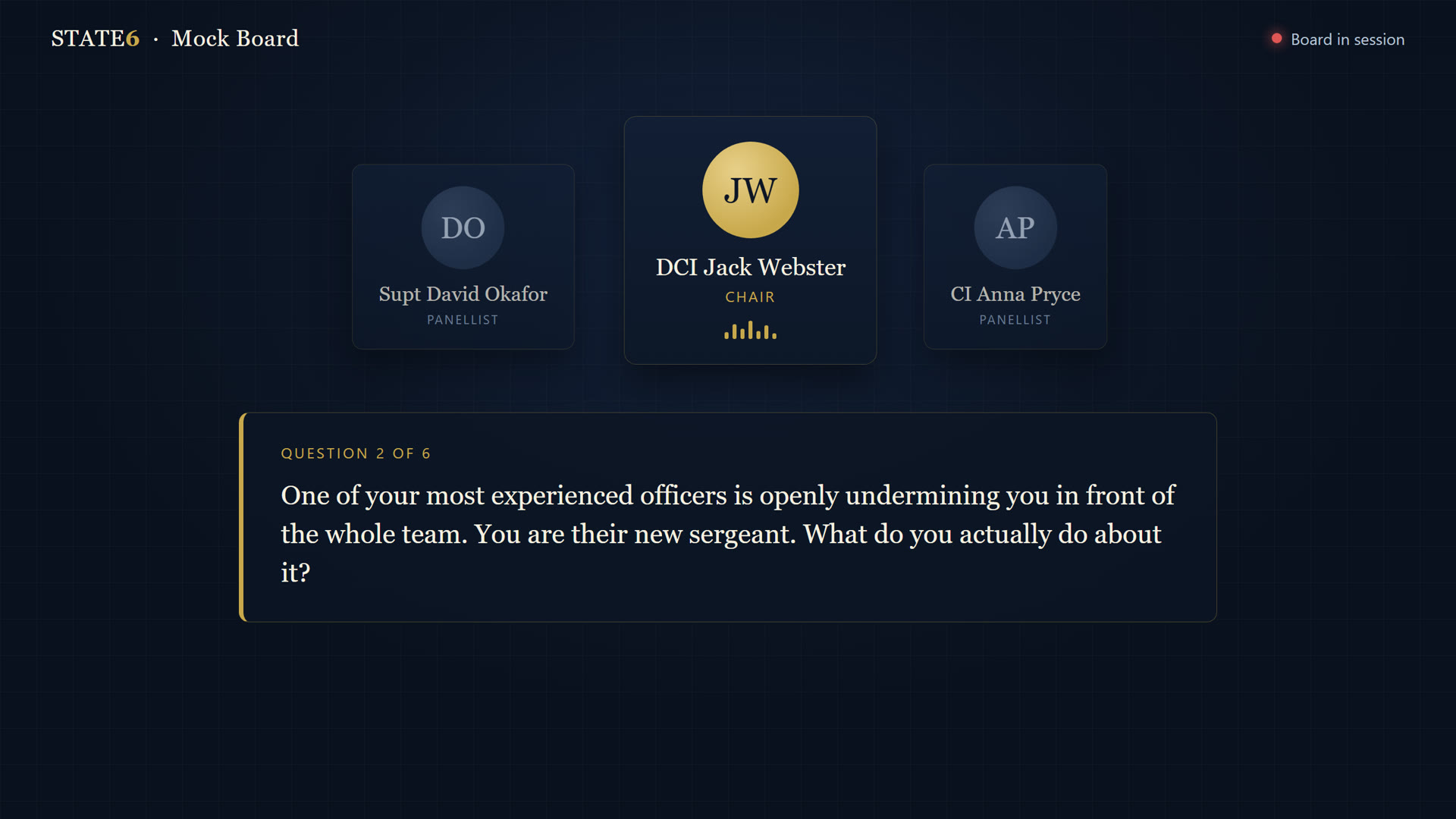
State6 is the only prep tool built on the Met's actual model. It generates future-focused questions for the Inspector round, marks your answer against the real 1 to 4 scale and the five indicators, and flags a target-chasing answer before a panel hears it. There's also a voiced Met mock board you sit out loud.
For a complete overview of the promotion process, from how the National Police Promotion Framework (NPPF) works through to what panels are scoring at each rank, see the Met promotion guide and the complete guide to UK police promotion boards.
You can try the Met review free. Start your free trial and answer a future-focused question marked 1 to 4 on potential, no card needed.