The Metropolitan Police Service no longer scores you on how well you've done. It scores you on how well you're likely to do at the next rank.
That single change is what trips up experienced officers preparing for the Met potential interview. They walk in ready to prove they're a strong performer today, and the panel is marking something else entirely: their capacity to perform tomorrow, judged forward, not backward. If you've searched for what is potential in police promotion, or what the Met 1 to 4 scoring actually measures, this is the part nobody explains clearly.
What does "potential" mean in the Met promotion interview?
Potential is your assessed capacity to perform at the rank you're applying for, not the rank you currently hold. As set out on the Met's officer promotion overview, the future-focused interview asks how you would lead and decide in the role above you, so it's measuring trajectory rather than track record.
This is the deliberate logic of the Met's reform direction under A New Met for London, its published plan for rebuilding the force. The Met isn't trying to reward the best constable or the best sergeant. It's trying to identify who will be a capable inspector before they've ever done the job.
A past example still has a place. You can use one to illustrate how you think. But if your whole answer is a war story about something you handled last year, you've answered a question the panel didn't ask. The full shape of that shift is covered in our guide to the Met future-focused interview.
What is the Met 1 to 4 scoring scale?
The Met assesses potential on a four-point scale: 1 Limited, 2 Developing, 3 Acceptable, 4 High. Whole numbers only, no half marks, and no fifth point. In the Met's potential model, every scored area of the interview lands on one of those four ratings.
The framing of each band matters more than the number, and in practice the labels point to this. A 1, Limited, means the evidence of potential isn't there yet. A 2, Developing, means it's emerging but not consistent. A 3, Acceptable, means you've shown enough to operate at the next rank. A 4, High, means you've shown clear capacity to thrive there, not just survive.
The Met has not dropped the Competency and Values Framework (CVF). The CVF and the Met values still underpin the criteria the panel is working to. What changed is that the CVF is no longer the test itself. The test is a forward-looking interview marked 1 to 4 on potential, with the framework sitting underneath it rather than in front of it.
How does 1 to 4 potential differ from the CVF 1 to 5 scale?
The other 42 forces score past examples against the College of Policing Competency and Values Framework typically on a 1 to 5 scale, marking how well a behaviour was demonstrated. The Met's 1 to 4 scale marks something different: how much potential you've shown to perform the next role.
One is a measure of competence already proven. The other is a measure of capacity not yet tested. That's why a strong CVF answer, dropped straight into a Met interview, can still score low. It proves you did something well. It doesn't, on its own, prove you'd lead well at the rank above. If you want the contrast in full, our explainer on the CVF 2024 scale sets out the 1 to 5 scoring most of the country still uses.
What are the five indicators of potential the Met assesses?
The Met looks for five signals of potential across the interview. They run underneath the questions rather than being asked one by one, so the panel is reading for them in how you answer, not what box you tick.
- Learning agility: how quickly you take on new knowledge, drop habits that no longer work, and apply what you've learned to an unfamiliar problem.
- Self-awareness: knowing your strengths, naming your growth areas honestly, and understanding how you land on other people.
- Curiosity: a genuine pull to ask why, dig into what's behind a problem, and look for a better way rather than the familiar one.
- Leadership behaviours: how you influence, bring people with you, and take the initiative before you're told to.
- Alignment to the Met's principles and values: whether your behaviour actually role-models them, including under pressure, rather than just describing them.
What separates a 2 from a 4 on the Met potential scale?
A 2 describes potential. A 4 demonstrates it. That's the whole gap, and it's the gap most officers miss.
An officer scoring a 2 says the right words. They tell the panel they're open to learning, that they reflect, that they involve their team. It sounds reasonable, and it sounds like every other candidate, because asserting a quality is not the same as evidencing it. Here's what that sounds like in the room.
WEAK
I'm very self-aware as a leader. I always reflect on my decisions and I'm open to feedback. I think that's something I'd bring to the inspector role, because I'm constantly looking to improve and develop the team around me.
Nothing there is wrong. It's also unscoreable, because there's no evidence underneath it. The panel can't tell an officer who genuinely does this from one who's learned to say it. A 4 closes that gap by showing the quality in motion.
STRONG
As an inspector I'd be inheriting a team I haven't led, so my first move would be to test my own assumptions before acting on them. The risk I'd watch in myself is moving too fast on a confident read of a situation, because that's caught me out before. So I'd hold my early judgements lightly, ask the sergeants what they're seeing that I'm not, and change course publicly if the evidence points the other way. I'd know it was working when people started telling me things I didn't want to hear.
That answer never claims self-awareness. It shows it, names a specific blind spot, and builds a mechanism to catch it. It also shows learning agility and curiosity without labelling either. That's what the difference between a 2 and a 4 looks like.
How do you show potential rather than just describe it?
Anchor every answer in the role you're applying for, then make the indicator visible through a decision rather than a claim. Show the panel how you'd think your way through a problem at the next rank, including the part where you change your mind.
Integrity sits across all of this and is assessed directly. An answer that quietly games a metric or chases a target at the public's expense isn't a clever leadership move in the Met's eyes. It's a serious concern, and it pulls the whole answer down regardless of how polished the delivery is. The five Success Profile areas the interview is built around, Integrity, Leads Inclusively, Being Resilient, Planning and Prioritising and Drives Engagement, are explored in our breakdown of what changed in Met promotion for 2026.
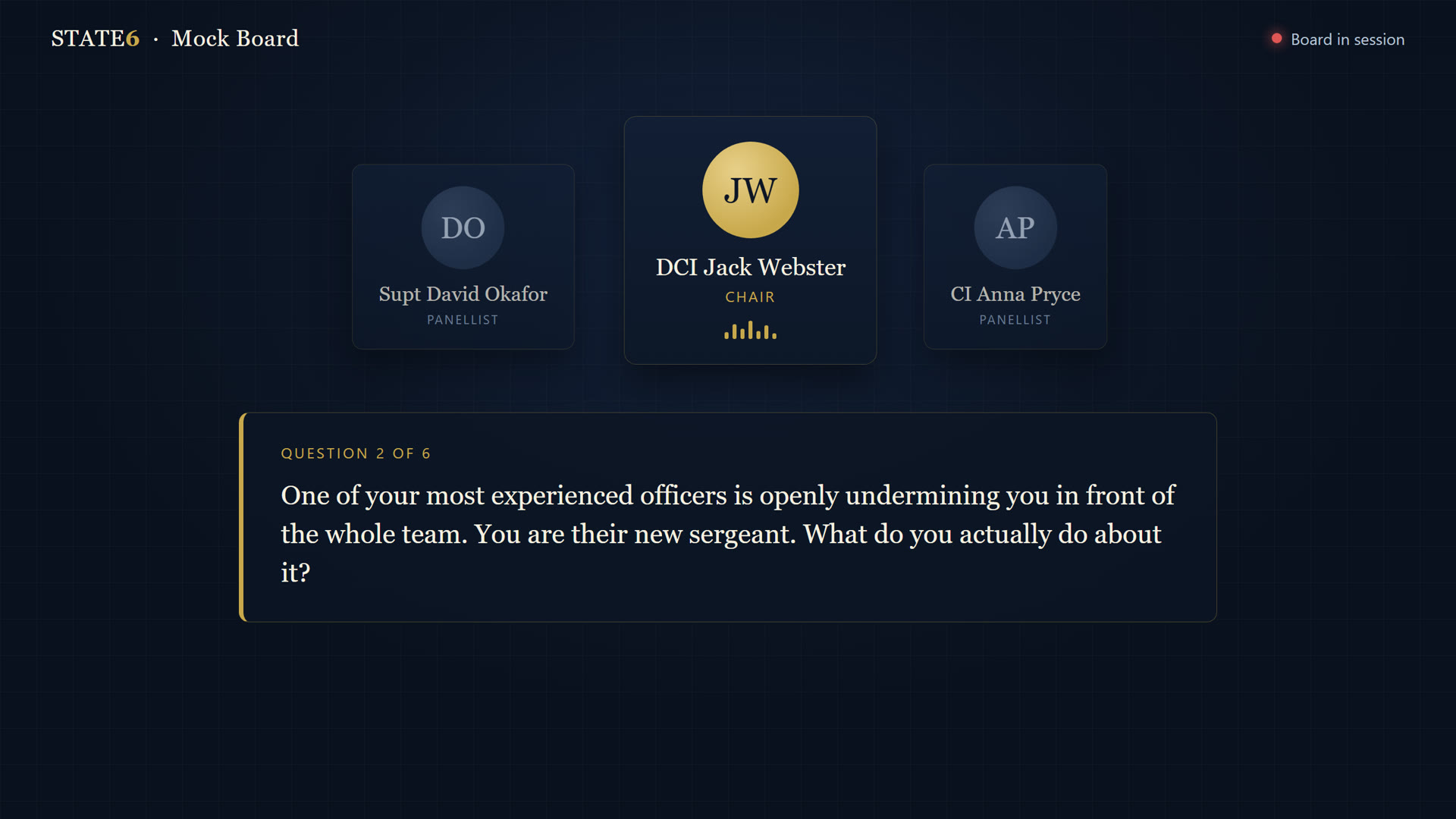
The hard part is judging your own answer. You can hear that you've made a claim, but you can't easily hear whether a panel would mark it a 2 or a 4. That's the exact gap State6's Met tools are built for. The 1 to 4 answer review tells you where you're landing on the potential scale before the panel does. The Met promotion guide brings the future-focused question generator, the 1 to 4 review and the voiced Met mock board together in one place.
State6 is the only prep tool built on the Met's actual potential model. For the wider picture of how Met promotion sits alongside the rest of the country's boards, see the complete guide to UK police promotion boards.
You can try the Met review free. Start your free trial and see where a real answer lands on the 1 to 4 potential scale, no card needed.