The Metropolitan Police Service no longer runs a promotion application form. To be eligible for Met promotion in 2026, you need a ready for promotion potential rating in your end of year review, and that PDR rating is now the gateway that decides whether you even get to apply.
This is the part of the new Met process that almost nobody explains. Officers spend months preparing for the interview and the leadership exercise, then discover they cannot enter the round at all because their performance review doesn't carry the right rating. The front door closed before they reached it. This post explains what the rating is, how the gateway works, what the gamified first stage involves, and how you earn a ready for promotion rating in the first place.
What is the Met's ready for promotion PDR gateway?
It's the eligibility check that replaced the old paper application. In its place the front door is now a short expression of interest, and whether you can put one in is gated by your PDR. As currently published, you need an end of year review showing a performance rating of at least at the standard, and a potential rating of ready for promotion or above. Without both, you're not eligible to enter the round for the next rank.
The logic behind it is straightforward. The Met decided that a snapshot application form, written in a fortnight by an officer who'd never written one before, was a poor predictor of who would actually lead well at the next rank. A year of recorded performance and a line manager's judgement on potential is harder to game and closer to the truth. That's the thinking the reform plan, A New Met for London, sets in motion across the whole assessment.
The practical consequence is that promotion preparation now starts a full year earlier than most officers assume. By the time the round opens, the gateway is already decided.
How does the Met promotion gateway actually work in 2026?
The PDR rating is the gate, and the gamified first stage is what you sit once you're through it. As currently published, for the Inspector round the gateway runs in three steps:
- Your line manager records a potential rating in your end of year PDR.
- A ready for promotion rating unlocks your eligibility for the round.
- Eligible officers then complete the gamified Stage 1 before any assessment centre.
So there are two filters before you reach the interview. The PDR decides whether you can enter at all. Stage 1 then filters who progresses to the assessment centre, where the Role Specific Leadership Exercise (RSLE) and the future-focused interview sit. Each filter removes people, so a weak PDR rating doesn't just cost you points, it ends the round before it starts.
This is a structural change from the College of Policing Competency and Values Framework model the other 42 forces use. It's covered in full in our guide to what changed in the Met process, but the headline for the gateway is simple: the front of the process moved from an application you write to a rating someone else gives you.
What is the gamified Stage 1 in Met promotion?
Stage 1 is an online psychometric assessment, delivered in a gamified format rather than a traditional question paper. As currently published, it's the first sift the Met uses once you're eligible, and it measures the underlying aptitudes and behaviours the role calls for rather than your knowledge of policy.
Gamified means the assessment is built around interactive tasks that respond to how you actually decide under time pressure, not multiple choice recall. The point is to measure judgement and consistency in a way that's harder to cram for than a knowledge test. We won't invent the exact tasks or duration here, because the format is not something to second guess. Treat it as a measure of how you think, not what you've memorised.
The honest preparation advice is to take any practice version seriously, do it rested rather than at the end of a night shift, and read the instructions for each task properly before you start. Rushing the first thirty seconds of a timed task is where most avoidable marks go.
How do you earn a ready for promotion rating in your PDR?
You earn it by giving your line manager specific, current evidence that you're already operating at the next rank, not by asking for it near the deadline. A ready for promotion rating is a judgement about potential, and judgements need something to stand on.
The mistake officers make is treating the PDR conversation as an annual formality and then being surprised by the rating. The officers who get the rating have made their case visible across the year. They've taken on work that stretches beyond their current rank, they've recorded it, and they've made sure their manager saw it as it happened rather than reading about it in a self assessment in March.
Below is the difference between a case a line manager can defend and one they can't.
WEAK
I've had a good year and I'm keen to progress. I act up when the sergeant's off and I get on well with the team, so I'd like to be marked ready for promotion this year.
There's nothing untrue in that. It's also not evidence. Wanting it, getting on with people, and covering gaps are baseline expectations, not signs of next rank potential. A manager can't take that to a moderation panel and defend the rating.
STRONG
Over the last year I led the team's response to the rise in residential burglary on the ward, I set the tasking, briefed the partners, and the series resolved. When the abstraction plan hit our cover I rebuilt the shift pattern so we held neighbourhood commitments without breaching anyone's rest days. I've recorded both, and I'd like us to look at what a ready for promotion rating would need from here.
Same officer, same year. The second version names what they led, what changed because of it, and the trade off they managed. That's a rating a manager can record and defend, because it describes someone already doing the next rank's job.
What does the ready for promotion gateway mean for how you prepare?
It means the work starts in your day job, long before the round opens. The same evidence that earns the PDR rating is the raw material you'll draw on later, so building it deliberately does double duty.
The Met assesses potential on a 1 to 4 scale, where 4 is High and 1 is Limited, against indicators like learning agility, self-awareness and curiosity. That same potential thinking underpins the PDR judgement your manager makes. If you understand what the 1 to 4 potential scale is measuring, you understand what a ready for promotion rating is really asking of you. The Competency and Values Framework (CVF) and the Met values still underpin the criteria, but the gateway is about forward potential, not a tally of past examples.
One thing to hold onto: integrity is assessed directly later in the process, and it starts here. A PDR built on inflated claims or numbers chased at the public's expense is a liability, not a strength. What panels look for at Inspector level is the officer whose evidence holds up under questioning, which means it has to be true before it's written down.
Where State6 fits
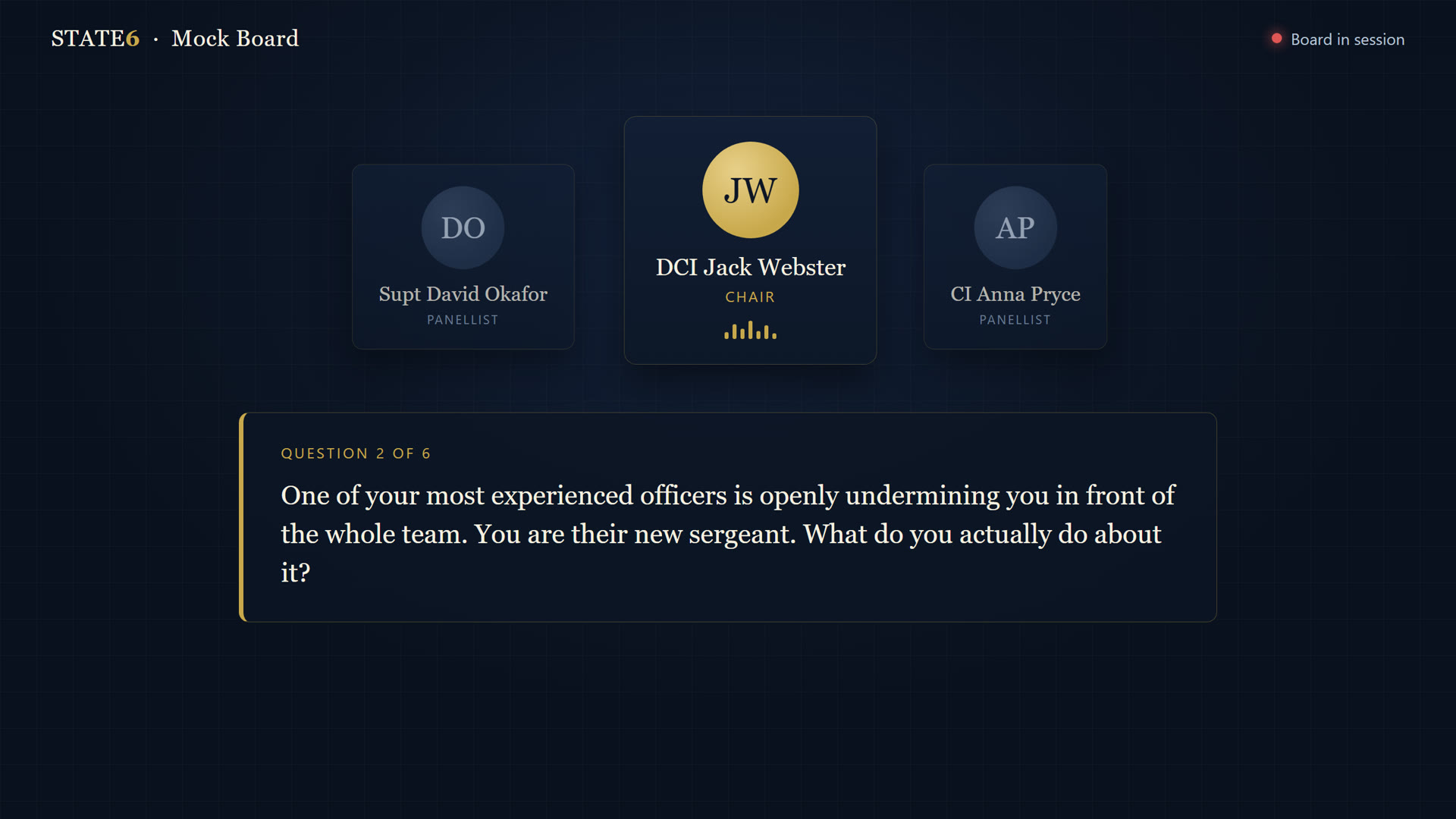
State6 is the only preparation tool built on the Met's actual model. It marks your answers against the real 1 to 4 potential scale and the five indicators, tests the integrity of your approach, and runs a voiced Met mock board so the future-focused interview isn't the first time you've said an answer out loud. The gateway gets you into the round. State6 is built for what comes after it.
For the full picture of how the Met round fits together, and how it differs from the standard process across the other forces, start with the Met promotion guide. And for how the National Police Promotion Framework (NPPF) and the wider promotion process work across UK policing, see the complete guide to UK police promotion boards.
You can try the Met review free. Start your free trial and rehearse the future-focused interview marked 1 to 4 on potential, no card needed.