Devon and Cornwall Promotion Board Preparation
If you’re preparing for a Sergeant, Inspector or Chief Inspector board at Devon and Cornwall, your panel already knows your force’s inspection picture. Here’s what that means for you, and how State6 builds it into your preparation.
PEEL report
3 June 2026
2025-27 PEEL assessment
Grades
8 areas
Causes of concern
2
in the latest PEEL report
HMICFRS support level
Level Three
More serious or systemic issues, moved here 25 September 2026. What this means
Devon and Cornwall HMICFRS snapshot
What the inspectors found
Devon and Cornwall Police has made improvements since the previous inspection, particularly in its financial management, control room performance, and crime prevention work.
PEEL grades
- Investigating crimeInadequate
- Protecting vulnerableInadequate
- WorkforceRequires improvement
- LeadershipRequires improvement
- Managing fraudRequires improvement
- Responding to publicRequires improvement
- Police powersAdequate
- Preventing crimeAdequate
Causes of concern
- The force hasn't made enough progress in improving the standard of its investigations since the 2023-25 PEEL inspection. Investigation plans were not followed in a significant number of cases, too many victims had not received an adequate service, not all investigative opportunities had been taken, and supervisors did not have sufficient time to complete all required supervisory tasks.
- The force is failing to effectively safeguard adults and children who are at risk of harm. Public protection notices were of inconsistent quality, over 8,000 domestic abuse PPNs dating from October to December 2025 had not been reviewed, secondary Domestic Abuse Risk Assessment processes had not been fully implemented, and the force could not show it understood the risks of serious harm to victims while no secondary risk assessments were taking place.
Areas for improvement
- The force needs to show it considers, analyses and evaluates changes to its processes, policies and procedures.
- The force needs to improve its leadership standards, behaviour and culture to make sure its workforce feels valued.
- The force needs to improve its operating model to make sure it uses resources effectively and promotes collaborative working.
- The force needs to improve its understanding of how continuing professional development supports its workforce by developing an effective evaluation process.
- The force needs to invest in its professional development review process to make sure that its workforce understands the value of recording personal development.
- The force needs to communicate better with members of its workforce and act on information and feedback to improve their well-being.
Show the other 14 areas for improvementHide the extra areas for improvement
- The force needs to make sure that officers complete safeguarding referrals for children when they have stopped and searched or used force against them.
- The force needs to make sure that when officers use force, they record the incidents effectively.
- The force still needs to encourage a problem-solving culture and to make better use of its existing systems to monitor and evaluate problem-solving activity.
- The force needs to improve how it manages abstractions to make sure its neighbourhood policing officers can fulfil their roles.
- The force needs to attend calls for service in line with its published target attendance times.
- The force should make sure it assesses ongoing risk when incidents are allocated to other departments.
- The force should make sure that the control room has sufficient oversight of incidents that are held in other areas of the force.
- The force should make sure that crimes are allocated to appropriately skilled investigators.
- The force needs to consistently achieve appropriate outcomes for victims.
- The force needs to improve how it records rapes and crimes committed against victims of domestic abuse.
- The force needs to effectively manage the preventative orders it applies for.
- The force needs to protect its communities from the risk of fraud.
- The force needs to provide effective training for all investigators and call takers and to continuously evaluate its capability to respond to and investigate fraud.
- The force needs to record fraud in line with national guidance to prevent unnecessary demand.
20 areas were identified in the full inspection. Inside State6, each is mapped to the CVF competencies it affects, so you know exactly what to evidence.
Source: Devon and Cornwall’s inspection reports on the HMICFRS website.
In their own words
What Devon and Cornwall says it is focused on
The inspection picture above is what HMICFRS found. These are the priorities Devon and Cornwall and its commissioner have set for themselves, and the people on your panel work to them every day.
Police and Crime Plan 2025 to 2029
Set by the Police and Crime Commissioner for Devon, Cornwall and the Isles of Scilly. The plan sets out how each priority will be tackled in town and city centres, in countryside and coastal areas, on the roads, and in homes and neighbourhoods. Stated aim: Safe, resilient, connected communities where everyone plays their part to reduce crime.
Read the plan on the commissioner's website
Our purpose, mission and values
Set by Devon and Cornwall Police. This is a standing statement of purpose and mission rather than a plan with a set period. Stated aim: Community policing delivered with competence, compassion and a common-sense approach.
Use these to choose which of your examples to tell, not as phrases to recite. An answer about a team problem lands harder when the panel can see it serves something the force has already said matters.
Priority names are the publishers’ own headings. The summaries are ours. Checked against the published documents on 20 September 2026.
Recent inspection activity
Inspections published since the last full PEEL assessment. These are often the most current picture of Devon and Cornwall, and the areas your panel is most likely to be conscious of right now.
Accelerated cause of concern · 25 September 2026
Devon and Cornwall Police: accelerated cause of concern
In August 2026, HMICFRS revisited Devon and Cornwall Police to assess progress against two outstanding causes of concern from the 2025-27 PEEL inspection relating to investigating crime and safeguarding.
Other HMICFRS inspections
Other published inspections of Devon and Cornwall. Useful background, but the PEEL assessment above is the fuller picture.
Integrity inspection · 29 October 2025
A report into the effectiveness of integrity arrangements in Devon and Cornwall Police
Devon and Cornwall Police was graded 'Requires improvement' in all three areas assessed: vetting police officers and staff, upholding the standards of professional behaviour, and tackling potential corruption.
What this means for your board
Devon and Cornwall is graded Inadequate for investigating crime and protecting vulnerable people. Its Police and Crime Plan 2025 to 2029 leads with the priority “Antisocial behaviour”. Your panel knows both without looking it up, and an example that speaks to either is one they will recognise.
A promotion board at Devon and Cornwall isn’t only assessing whether you can lead a team. It’s assessing whether you understand the force you’re asking to lead in, and where your leadership fits its priorities. Officers who connect their examples to what Devon and Cornwall is actually focused on stand out. Officers who stay inside their own team don’t.
You don’t do this by quoting the inspection report. You do it by letting your force’s priorities shape the decisions in your answers. If you want the full method, read our guide on what HMICFRS grades mean for your promotion board, or compare every force’s PEEL grades side by side.
How State6 prepares you for Devon and Cornwall
You don’t have to research any of this yourself. Devon and Cornwall’s real HMICFRS picture is built into State6. The Question Bank shapes practice questions around it, and every AI Board Review weaves your force’s context into the feedback on your answers. You’re preparing for the board you’ll actually sit, at the force you’ll actually sit it in.
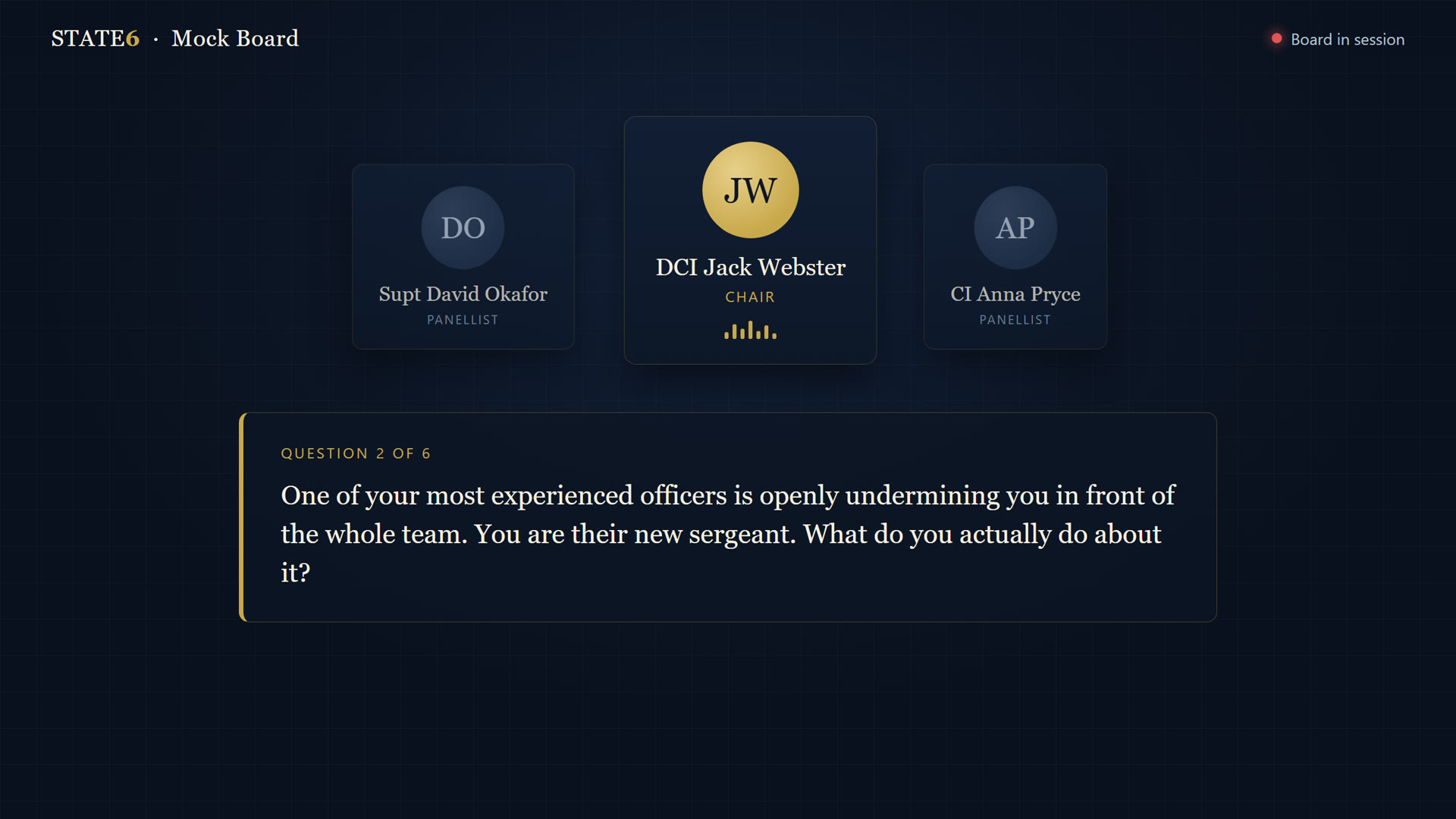
You can also sit a full voiced AI mock board calibrated to Devon and Cornwall’s inspection picture, answering out loud while the panel listens, probes and scores you against the CVF 2024.
Calibrated to your target rank, too. See what panels look for at sergeant, inspector and chief inspector level.
Prefer to start free? Our free promotion board question bank gives you real questions for every CVF area at sergeant, inspector and chief inspector level, free to download as you prepare for your Devon and Cornwall board.
Prepare for your Devon and Cornwall board
Practice questions, AI board reviews and your force’s inspection picture, all in one place. Try it free first: one AI Board Review, ten practice questions, fifteen coaching rounds and one spoken mock board question, no card needed.
State6 is an independent preparation platform and is not affiliated with, endorsed by, or connected to Devon and Cornwall, the College of Policing or HMICFRS. Inspection findings are summarised from the publicly available HMICFRS PEEL reports.
HMICFRS inspection data: Contains public sector information licensed under the Open Government Licence v3.0.