Plenty of boards are lost in the weeks after the sergeants' exam, while you wait on NPPF Step Two results and put the board out of your mind. That wait is where the time goes, long before anyone fills in a form.
You revised Blackstone's through a set of nights. Give the board at least the hours you gave the exam.
What the pass gets you
The NPPF has four steps, and the exam is the second. Step one was eligibility, including your line manager signing off your PDR before you could sit.
Step two is the legal exam the College of Policing runs nationally, 150 questions in three hours on a syllabus that ate your rest days. Its candidate handbook says results and feedback reach you within three weeks of the exam. A pass stays valid for five years, but it doesn't get you the rank.
Don't undersell what you've done. The Police Leadership Commission report puts the average pass rate from March 2024 to October 2025 at around 54 per cent for the sergeants' exam and 31 per cent for the inspectors'. If you passed for sergeant, you're in the half that got through. If you passed for inspector, you're in rarer company still.
Your force's timetable, not the College's
Step three is your force's own selection process, on its own timetable. Some forces open a process within weeks of results, others once or twice a year, so the gap can run to months.
Outside the Met, the usual shape is an application or evidence stage against the Competency and Values Framework (CVF), then a panel interview. That interview is the board. Some forces add a presentation and some don't, so take what a mate in another force tells you with a pinch of salt.
The Met runs a future focused interview scored on potential, so read what's changed in Met police promotion first, because CVF boards work differently. The same goes for the five forces piloting the Sergeant and Inspector Promotion and Progression process, SIPP (as at July 2026): your force's own guidance trumps everything here.
The questions on the day
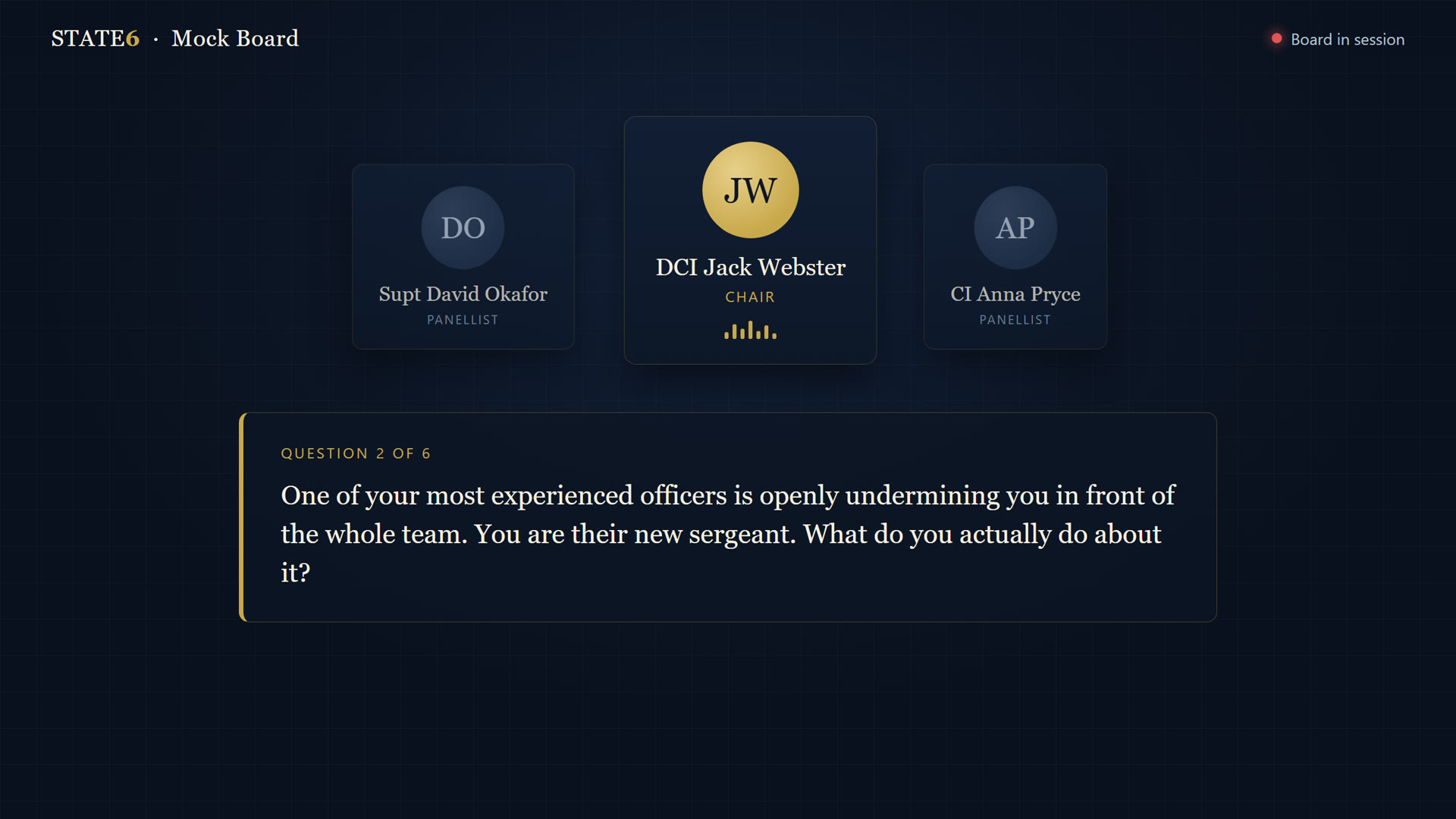
Picture a first question like this: tell us about a time you had to challenge a colleague whose standards had slipped. It sounds like a gift, until you spend two minutes on the background and thirty seconds on what you did and what changed. You won't know your questions until the day, but that's the shape of them.
Those behavioural questions are marked against CVF Level 2, the level for both sergeant and inspector. The panel wants something you did yourself, with a result they can score, and a STARR answer is the usual way to hold it together.
Expect forward facing questions too: something you haven't dealt with yet at the new rank, and how you'd think it through. They need a different shape, set out in how to structure forward facing questions. Panels often expect you to know what your force's HMICFRS grades mean.
If your examples are all from response, they'll do if they show you leading at the level you're applying for, and a job you ran on a busy Friday night proves that as well as any project. The bar differs at sergeant and inspector level.
The trap after the exam
The exam rewards recall and the board doesn't. Your force will often have more passes than posts, and the board is where that gets settled.
We've all watched a strong officer tell a brilliant job at a board and still miss out, because the panel couldn't tell what they did themselves, and what they did was the work rather than the leading. The panel is scoring whether you got the best out of other people.
One submission to the Commission said that “being able to pass an exam does not make you a leader”. The Commission's recommendations on promotion include moving the exam later, so that leadership capability becomes the main test of whether you're eligible for promotion.
The weeks before your board
On results day, find your force's promotion policy and put the likely window in your diary. Tell your line manager the same week: in many forces their support is part of the application, and it reads better when they've seen your examples.
In the first fortnight, write up your strongest real examples as first person accounts with a clear outcome. Check each one shows a different part of the CVF, and drop any that prove the same thing. Find out from your force policy how recent examples must be, and if you've had no chance to act up, ask your line manager for a spell now. A month of acting gives you examples at the rank that no amount of rewriting will.
As soon as you've written them, start saying them out loud. Record yourself on your phone in your own car before a late turn, and if you lose the thread at ninety seconds, so will the panel. If your force runs a presentation, practise the format now; you won't see the topic until your force issues it.
Two or three weeks out, sit at least one full mock board with someone who'll ask the awkward follow up questions a panel would, so you still have time to fix what it shows. It helps to know what a sergeant promotion board or an inspector board involves before you set it up.
After the board
A successful board puts you in line for step four once your force matches you to a post, and some forces hold a pool of successful officers until one comes up. Step four is temporary promotion and work based assessment, a mandatory twelve months for sergeants, which you must pass before the rank becomes substantive.
If it doesn't go your way, your pass still stands for its five years. Ask for feedback within the week, and ask which competency cost you marks.
The complete guide to UK police promotion boards covers the whole process. Before you open it, answer this honestly: which of your examples would you reach for first if the panel asked about challenging a colleague?