The inspectors' exam results come through, and within a day someone asks when your promotion board is. One of us had about six weeks between the result and the board. Yours may be longer or shorter, and your force sets the date.
This post is about using that gap for one thing: making your answers easy to mark.
Inspectors' exam results: the date and the pass mark
Results for the November 2026 inspectors' exam are expected on Thursday 26 November 2026. The pass mark is 65%, which is 91 correct answers out of 140, and a score of 85% or more is graded exceptional. Both figures are in the College's candidate handbook, checked on 14 November 2026.
Once results are released they are final. The College does not remark papers.
What the pass gives you
A pass means you've finished step two of the four steps in the National Police Promotion Framework. Step three is your force's own selection process, usually a promotion board, and the NPPF operating manual (July 2026) says your force must advertise early how it will run. Step four is temporary promotion with a work-based assessment. Your pass stays valid for five years, less one day: if you sat on 3 to 5 November 2026, you must have taken the final stage of step three by 4 November 2031.
Find your force's promotion page, or ask HR, for the dates and the format. The rest of this post applies whatever the format turns out to be. The Met runs a different route, covered in our posts on the Ready for Promotion PDR gateway and the future-focused interview.
Our earlier post on what the promotion board asks after the exam covers the sergeants' route and what happens after the board.
What it's like on the other side of the table
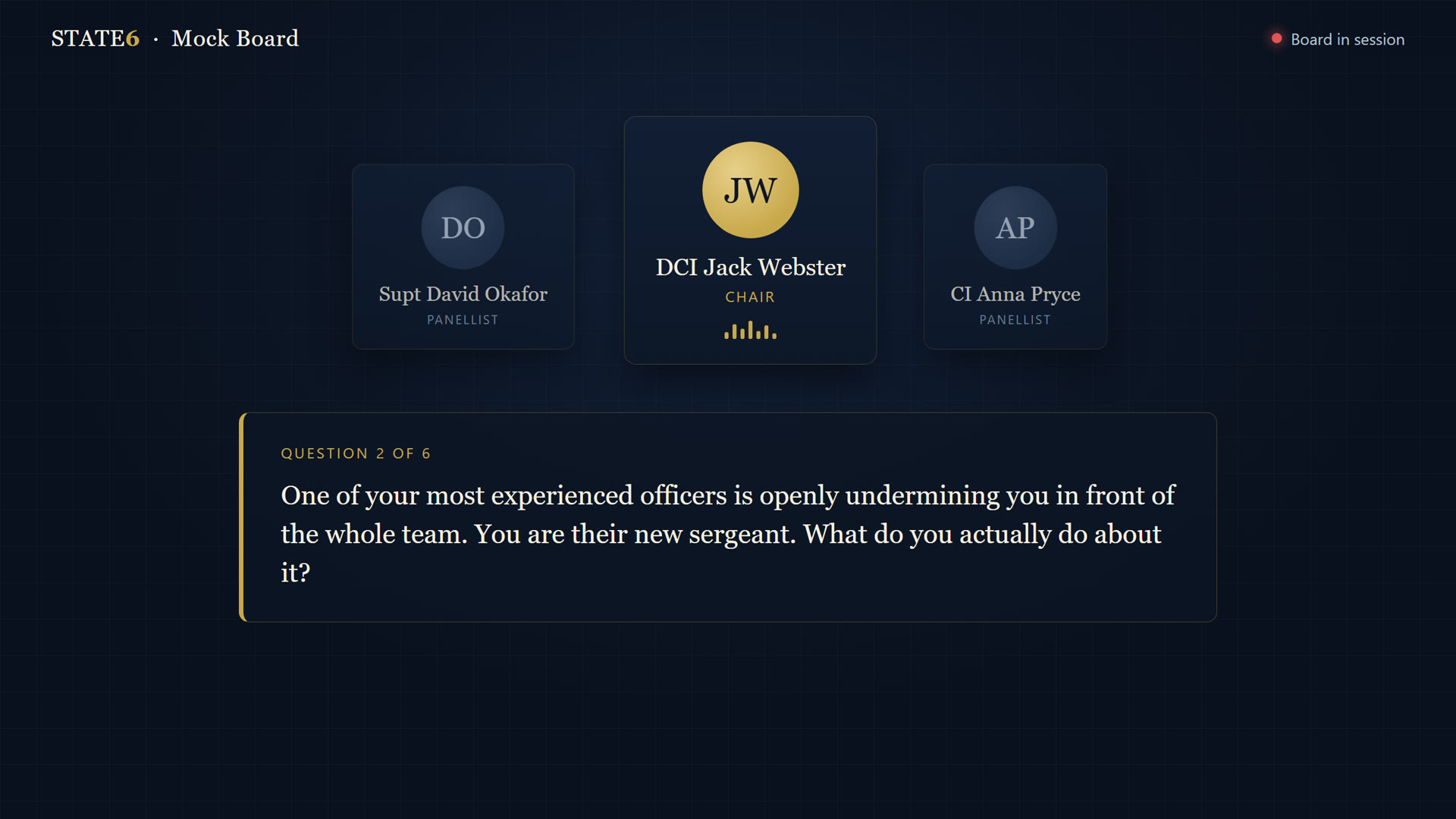
One of us marks candidates on promotion boards. This is how he describes it.
Candidates who talk with composure and structure always do better. They're easier to mark. I don't have to go looking for the content, because it's obvious, so I listen to the answer. With the others I'm making lots of notes and then trying to unpick the example.
A hard-to-mark answer shows itself in the first half minute. It rambles. If the question asks for something you've done, there's no clear Situation, so the panel doesn't know what was going on. If it asks what you would do, there's no Position, so the panel doesn't know what you think. Our guides to the STARR structure and forward facing questions cover both openings.
The question won't tell you the rank
What surprised one of us most about his own inspector board was how plain the questions were. They could have been asked at any rank. It was down to him to put the meat on the bones.
So the level has to come from your answer. From the panel side, a candidate who is still thinking as a sergeant gives it away in the words and examples they choose. They stay inside their own team and miss the wider effect on the organisation.
Here is one made-up story told twice. The sergeant version: “My team's open investigations were piling up, so I reallocated cases and held weekly reviews until we'd cleared the backlog.”
The inspector version: “Open investigations across my three sergeants' teams had risen by a third in two months, and victims were waiting longer for updates. I agreed a target with all three sergeants, moved two officers from the quieter team for six weeks and told the superintendent what that would cost us elsewhere.”
The job is the same. The second version shows who you led through and what it meant beyond your own teams. Our post on what panels look for at inspector level goes further.
Choose your examples the dull way
Before his own board, one of us tried to prepare an example for every part of the Competency and Values Framework (CVF), and leaned towards the jobs that sounded most exciting. It was too much to remember and none of it was required.
A good example has a result at the end and something you learned and have used since. An ordinary job that passes that test is a strong example.
Be careful whose advice you take
After passing his exam, one of us paid for an hour of phone coaching with a retired officer. It was of limited use. The advice was built on an older promotion structure. And an hour was too short: the useful questions only came to him days later, once he'd had time to digest it, and by then there was no follow-up.
Asking a senior officer is the usual advice, and it has the same weakness. Rank doesn't make someone the right person to help you through a board, and asking lots of people muddies your thinking. Before you take anyone's advice, ask when they last sat on a board, or went through one, under the current process.
Our view
We think the interview rewards whoever has a structure. That's a weakness in how forces select, and it's also your opening, because structure can be learned in the weeks you have.
A plan for the gap
In the first week, find your force's dates and format. Pick a small set of examples that each have a result and a lesson.
In the middle weeks, write each one out, then rework it at inspector level: who did you lead through, and what did it change beyond your team? Practise opening a “how would you” answer with your position.
In the last week, say your answers aloud against a timer, and get someone to ask follow-up questions.
The night before, go over your revision cards once and leave it at that. Skip the late study session and get some rest.
If you didn't pass this time
The next inspectors' exam is on 11 to 13 May 2027, with registration open from 15 March to 15 April 2027. Those dates are from the College of Policing's NPPF step two page, checked on 14 November 2026, so confirm them with your force. The board preparation above still counts when you get there.
One thing to do today
Record yourself on your phone answering “Tell me about a time you improved performance”. Play back the first 30 seconds and ask whether a stranger would know what was going on.
Our free Inspector promotion guide covers all of this in 21 pages, with a worksheet for your own force and one question answered twice.
For how the whole process fits together, from the NPPF steps to what panels score at each rank, see our complete guide to UK police promotion boards.